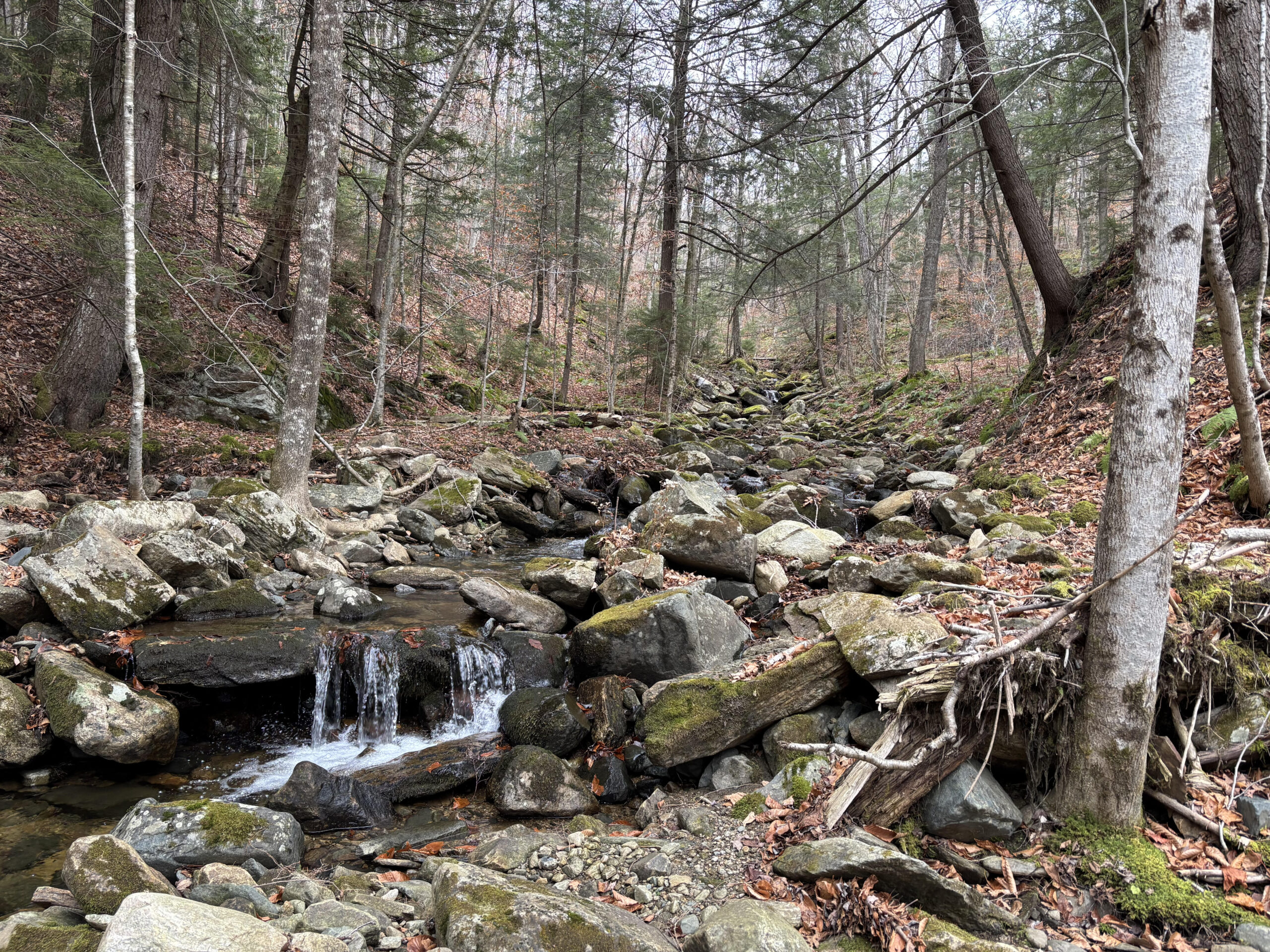
On December 12, 2025, the Mount Holly Conservation Trust completed the acquisition of the 33.5-acre Maple Crossing parcel along Route 100. This forested property sits in a critical location between the recently conserved Awasos Wildlife Management Area and Okemo State Forest, helping secure an important piece of an already significant conservation landscape.
The acquisition was supported by a generous grant from The Nature Conservancy’s Vermont Biodiversity Protection Fund.
Maple Crossing is modest in size, but it occupies an outsized position on the land. It lies within a mapped high-priority landscape for connectivity, riparian protection, and surface-water protection, and includes more than 2,000 feet of frontage on several tributaries of the West River.
Why this land matters
The parcel is entirely forested and helps hold together a larger habitat block in the Okemo region. It sits at the southeastern end of a 12,700-acre habitat block around Okemo Mountain, in an area where development pressure along Route 100 is substantial.
The forest itself is a mature northern hardwood stand with strong ecological value. The land contains scattered bear-scarred beech trees, and the adjoining northern hardwood forest on the Pace property is mapped as a Significant Natural Community. State foresters who visited the parcel concluded that the forest on Maple Crossing is very similar to the adjoining stand and likely extends that same community. The site also appeared not to have been managed for at least seven decades.
Maple Crossing also protects important headwater stream habitat. Several tributaries of the West River cross the property. These cold-water streams support brook trout and other aquatic life, and the intact forested buffers on the parcel help protect water quality, flood resilience, and stream function downstream.
Fish and Wildlife surveys upstream of Route 100 estimated a minimum of about 1,400 brook trout per mile in 2024 and about 2,300 brook trout per mile in 2025. August water temperatures recorded during those surveys were 58°F in 2024 and 62°F in 2025, conditions well suited to brook trout.
A connected landscape
Maple Crossing adds protection where it matters most: at the seam between existing conserved lands. The parcel lies directly across Route 100 from Awasos WMA and abuts Okemo State Forest, creating a stronger protected landscape for wildlife movement, forest resilience, and long-term ecological health.
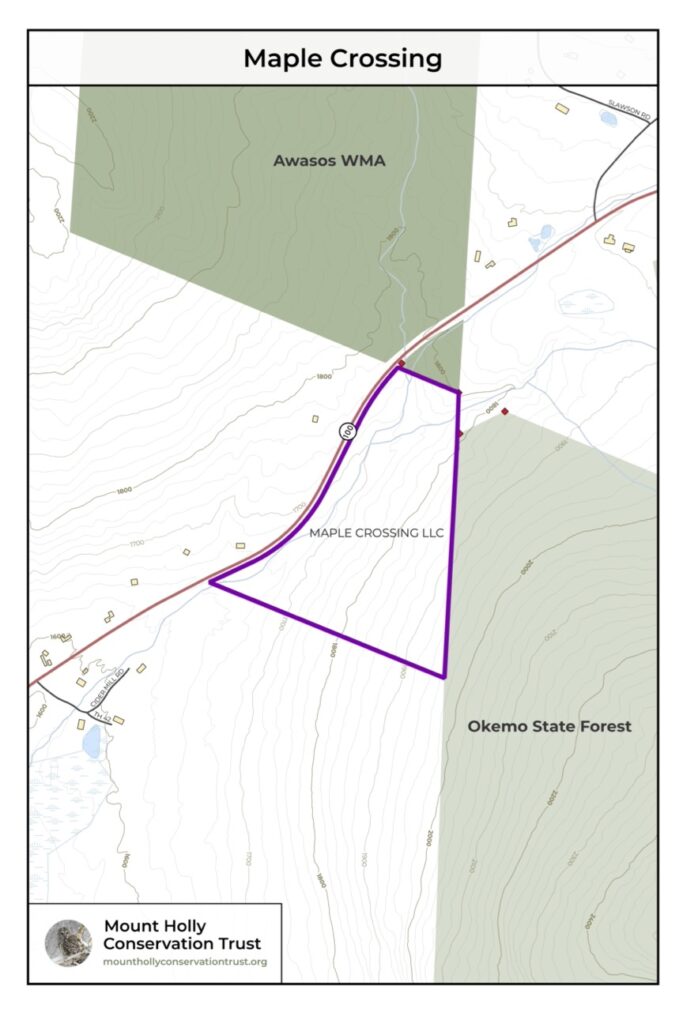
This acquisition also has a public dimension. By protecting land next to Awasos WMA and Okemo State Forest, Maple Crossing helps secure wildlife habitat and expands opportunities for low-impact, wildlife-based recreation, including birding, hiking, hunting, and angling.
What comes next
MHCT acquired Maple Crossing because parcels in locations like this do not come along often. Protecting this tract keeps an important forest connection intact, safeguards headwater streams, and advances long-term conservation in one of the most important wildlife movement areas in southern Vermont.
To formally complete the connection between Awasos Wildlife Management Area and Okemo State Forest, MHCT plans to convey Maple Crossing to the Vermont Department of Fish and Wildlife later this year. The transfer will continue a conservation partnership between MHCT and the Department that began with the creation of Awasos WMA in 2022.